Every answer starts with the short version, then the detail. Nothing here replaces an inspection of your own property, but it should tell you whether one is worth arranging.
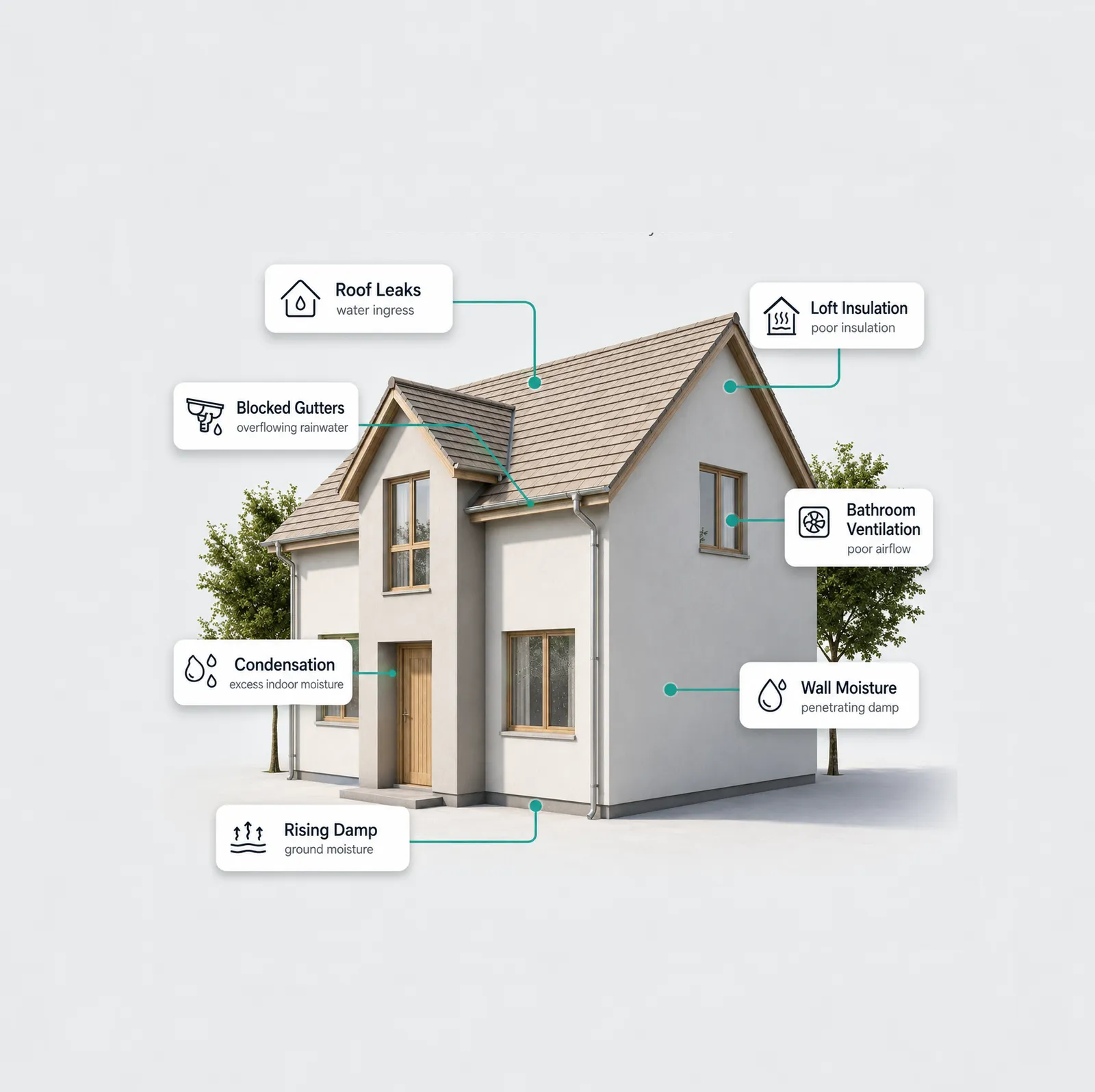
A damp and mould survey is an independent inspection that finds where moisture is coming from, not just where it shows. The surveyor uses moisture meters, thermal imaging and humidity readings to tell condensation, penetrating damp and rising damp apart, then reports the cause, the extent and the repairs that will actually fix it.
Essential survey: a targeted inspection of the affected area, taking 60 to 90 minutes.
Comprehensive survey: the whole property, including leaks, timber, ventilation and a follow-up consultation.
Every report includes photographs, readings and prioritised next steps, delivered within 48 hours.
Our independent damp and mould surveys cost £295 – £495 for a targeted inspection of the problem area, and £450 – £1,495 for a whole-property investigation. The price depends on the size of the property, how many rooms are affected and whether leaks, timber or ventilation also need to be assessed.
An Essential damp and mould survey usually takes 60 to 90 minutes on site, and a Comprehensive whole-property survey takes two to four hours. Larger or harder-to-access properties take longer. Your written report, with photographs, moisture readings and recommended repairs, arrives by email within 48 hours of the visit.
Clear access to the affected walls, the loft hatch and under-sink cupboards.
Do not redecorate the affected area before the visit, because it hides the evidence.
Tell us about recent leaks, building work or previous damp treatments.
Is it worth getting a damp survey?
Yes, if you can see damp or mould, or notice a musty smell that keeps returning. A survey costing a few hundred pounds identifies the actual cause, so you avoid paying thousands for treatments, such as a new damp-proof course, that will not work. It also gives buyers evidence to renegotiate and landlords a record of action.
Buyers: find out whether damp flagged in a survey is a gutter repair or a serious defect before you exchange.
Landlords: a written diagnosis and repair plan shows you investigated and acted on a reported problem.
Homeowners: stop mould coming back by fixing the moisture source instead of repainting over it.
Whoever commissions the damp survey pays for it. When buying a home, that is usually the buyer, often after a Level 2 or Level 3 survey recommends further investigation. Sellers sometimes commission one before listing to answer questions early, and landlords normally pay when a tenant reports damp in a rented home.
The report is written for the person who commissions it. If you are buying, commission your own rather than relying on the seller's.
If the survey confirms a defect, use the report to renegotiate or ask the seller to repair it before exchange.
Free damp surveys are usually offered by companies that sell damp-proofing treatments, so the inspection is part of a sales visit and the recommendation may be the treatment they install. An independent survey costs money up front, but the diagnosis is not tied to selling work, which is the reason to pay for one.
Ask any surveyor whether they, or a linked company, carry out the remedial work.
Be wary of a rising damp diagnosis based only on a hand-held moisture meter. These meters are calibrated for timber and read high on salts in plaster.
We do not sell treatments or carry out remedial work, so our findings are not influenced by sales.
Can rising damp ever be fixed?
Yes. Genuine rising damp is far rarer than it is diagnosed, and it is usually fixed by removing whatever bridges or overwhelms the damp-proof course: lowering raised ground levels, clearing debris, repairing leaking drains or gutters and replacing impervious renders or plasters. An injected chemical damp course is rarely the right first step.
Confirm it is rising damp first. Condensation and penetrating damp are far more common and need different fixes.
Older solid-wall houses need breathable lime plasters and renders; cement and gypsum trap moisture in the wall.
No, it is not illegal to sell a house with rising damp or any other damp problem. What matters is honesty: the seller must answer the property information form and the buyer's enquiries truthfully, and false or misleading answers can lead to a misrepresentation claim after completion. Many homes with damp sell at an adjusted price.
Sellers: a damp report before listing lets you price the problem in and answer enquiries with evidence.
Buyers: get the cause and the repair cost confirmed before exchange, while you can still renegotiate.
Not easily. Fresh paint, new plaster, furniture against walls or a dehumidifier running before the visit can hide the visible signs, but surveyors treat fresh decoration in a suspect area as a warning sign and use moisture meters and thermal imaging to find moisture beneath the surface. Concealing a known defect can also expose the seller legally.
Look for patches of new paint or plaster low on walls, in corners and around windows.
Notice musty smells, air fresheners in every room and furniture placed tight against outside walls.
Independent by design
Essential Damp & Mould Survey
Fast, independent diagnosis of visible damp and mould, with clear causes, photos and next steps.